
The following sequence of events took place in season 5, episode 11 of the American hit sitcom Friends (1999). In this episode, entitled ‘The One with All the Resolutions’, Ross Geller, one of the six friends, decides to buy and wear a very tight pair of black leather trousers. This sartorial choice is a surprising one for Geller, who works as a palaeontologist and is normally seen in soft-knitted tops, loose, casually styled shirts and suits that come in more than fifty shades of brown. Departing the familiar territory of his usual attire, Geller’s choice of trousers imbues the daring image created with the help of films such as Terminator and Matrix, and rock stars such as singer Alice Cooper and Slash, the guitarist from the hard rock band Guns’n’Roses. But it’s not until long into the episode that the trousers out-cool, and heat, our leather-clad main character. After seeking approval from his friends for his new look, which he never gets, and a date with a woman he met earlier in the episode, which ends after a number of uncomfortable moments that include awkward sound effects as well as a combination of talcum powder and body lotion, Geller returns home trouserless and defeated. He was unable to match not only the expectations set by symbolic weight, but also the practical dimensions of these tight black leather trousers.
Fashion is a double-edged sword. Mastering its complex rules requires a sophisticated understanding of the semantic codes embedded in cloth, and the wider contexts in which fashion is performed and that can render these very codes semantically unstable. It is not just about what you wear, but how, when, where and why you wear it. Many scholars divide our motivations to claim our presence through the ways clothing creates language into two crudely polarising categories. On one hand, they say we distinguish ourselves through dress by attempting to look a part. Yet at the same time, dress can be a form of resistance, whether through the refusal to participate or to play by the rules. In fact, the very function of fashion, which is never static but ever-evolving, could be attributed to a constant cyclical pursuit and rejection of distinction and resistance. This, in turn, is driven by a need to signal political, social, cultural and economic capital that manifests across all layers of the society and in all the layers of our clothing. For some, being in fashion is the ultimate goal, yet being too fashionable or appearing to try too hard will also be met with suspicion. Somewhere in-between is the Holy Grail.

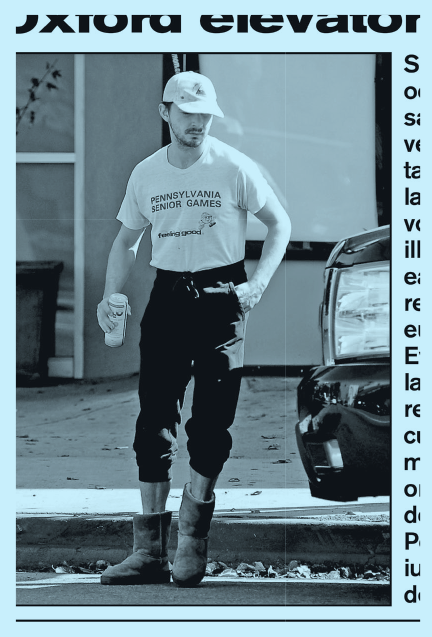
Scumbro’s Shia LaBeouf and Justin Bieber, 2017– 2019
Emphasis has always been put on the virtue of not trying, being effortless and appearing at ease while still exhibiting a level of refinement. The fine line between these contrasting ideals is perhaps what Italian Renaissance courtier Baldassare Castiglione describes as ‘sprezzatura’. His Il Libro del Cortegiano (The Book of Courtier), first published in 1528, provides a fascinating insight into Renaissance court life and deals with issues around etiquette, manners and behaviour as well as morals. This Italian diplomat defines the term in the following way:
It is an art, which does not seem to be an art. One must avoid affectation and practice in all things a certain sprezzatura, disdain or carelessness, so as to conceal art, and make whatever is done or said appear to be without effort and almost without any thought about it…. obvious effort is the antithesis of grace.
For him, sprezzatura was about being at ease with accomplishing difficult actions which hide the conscious effort that went into them. In dress, this would manifest itself in a certain level of self-restraint when it comes to decoration but, Castiglione advised, one should also try to avoid being bland in order to set oneself apart from the rest.
At first glance, flicking through a copy of Vogue Italia, British GQ or the US version of Harper’s Bazaar, you might think it is fashionable to dress in over-the-top head-to-toe all-the-bells-and-whistles outfits. But now, more than ever before, achieving the opposite ideal of sprezzatura is de rigueur. Certainly, you are unlikely to find style advice in fashion publications with titles such as ‘5 Ways to Look Like You Are Trying Too Hard’, ‘10 Outfits That Make You Look Stuck Up’ or ‘Winter Must-Have Jackets to Make You Look Very Un-Cool’. Instead, you can find contradictory advice on how to create make-up that appears make-up-less. Or perhaps the suggestion to get yourself an ‘effortlessly-chic’ pair of boyfriend jeans, now a legitimate category in the denim section. These borrowed trousers ‘strike the perfect balance between straight-leg and slouchy silhouette, with a classic mid-rise and authentic non-stretch denim’ as declared by British high-street retailer Topshop. They also say something about gender and fashion today when we are supposed to be attuned to subtle and potentially problematic cultural messages. For men, the latest fashion seems to be all about wearing classic w