
Although varied in uses and meanings, carpets that belong to the domestic realm and those tied to sacred rituals share a common ground: they are always places of exception, marking a space, separating it from its surroundings. The carpet turns what it frames into something unique and exclusive, and has the power of isolating the people and the objects that inhabit it, defining a ‘consecrated ground’ dedicated to an act apart, a place with its own rules, which orders the confusion of life into a temporary and limited perfection. Carpets embody powerful symbols across different cultures, becoming filters that enhance a suspension of reality, as they mark a ‘sacred’ spot in the house, represent the Garden of Eden, or delimit a holy ground for prayer. Carpets have always been embedded with ‘magic’: from One Thousand and One Nights, to Solomon’s green silk carpet, to the Russian folk tales of Ivan the Fool, to Mark Twain’s Captain Stormfield’s Visit to Heaven, the ‘flying’ carpet is a common trope in legends, myths and religions.
In contemporary Western domestic spaces the carpet is seen as a common piece of furniture, but unlike the chair, table or sofa, the carpet is often used to frame a living space and domestic ritual, the act of eating, or being together. The Western use of carpets started when the rug arrived in Europe, following conquests and trade with the Middle East, in the 13th century. Under the foot of the Virgin or on the church altar, a special place became dedicated to oriental carpets in Western culture.
Wealthy European leaders and merchants, who understood the power of the carpet’s symbolism by displaying them in their homes, often on tables as an indication of status and power, gave birth to a genre of painting, the 17th-century ‘still life’, where exotic food, birds and precious objects, placed on top of luxurious oriental carpets, would suggest complex allegories bound to life and death.


1. Lorenzo Lotto, Family Portrait, 1524. Courtesy Hermitage Museum, St Petersburg
2. Nicolaes van Gelder, Still Life, 1664. Courtesy Rijksmuseum, Amsterdam
The tradition of displaying Middle Eastern carpets on tables is portrayed in the paintings of Renaissance artists such as Lorenzo Lotto [1], Ghirlandaio, Holbein, Rembrandt, Vermeer and Memling. As an example, the ‘still life’ by Nicolaes van Gelder (1664), part of the Rijksmuseum collection, features an Anatolian prayer rug placed on a marble table, topped with baskets laden with peaches, grapes and plums, alongside precious glass and ceramic objects [2]. The habit of placing carpets on tables rather than floors still survives in popular culture in the Netherlands. So-called bruine cafés, such as Amsterdam’s Café Anno 1890 or Café Hegeraad, welcome clients with carpets instead of tablecloths on the tables, a tradition that traces back to the 16th-century carpets of Amsterdam merchants, and to their form of consideration for those skilfully crafted fabrics, far too precious to be carelessly walked upon.
Yet the Western use and understanding of carpets is only a fragment of the richness of meanings that the carpet embodies in the Middle East, which brought forth a world of carpet types and layouts: from the ‘Chahar Bagh’, representations of walled gardens, to ‘hunting carpets’ that depict the ‘zoological’ parks or hunting reserves of Persian princes inhabited by riders and fantastic animals interlaced with flowering foliage and imaginary branches, to ‘medallion carpets’ featuring abstract ponds or pavilions, ‘tree of life’ carpets with cypresses inhabited by birds, ‘millefleur’ carpets with fields of plants and catalogues of flowers, and ‘prayer rugs’, portable sacred ground to pray on, representing an opening towards the Garden of Eden, and ‘Saph’, multi-niched rugs used for collective prayers in mosque.
Paraphrasing the words of art historian Sergio Bettini, the carpet responds to one of the fundamental needs of human beings, the act of enclosing, defining, giving form to the living space. It serves as protection against the limitless scales of space and time. It is a place that is both house and temple, a place of shelter and leisure, and a place for prayer. The frame of the carpet cuts and delimits a portion of the infinite, devoting it to human existence. Within its finite boundaries, people frame the universe through its symbolic relationships, infinite representations, and multiple scales of meaning.
The Prayer Rug: A Visual Essay
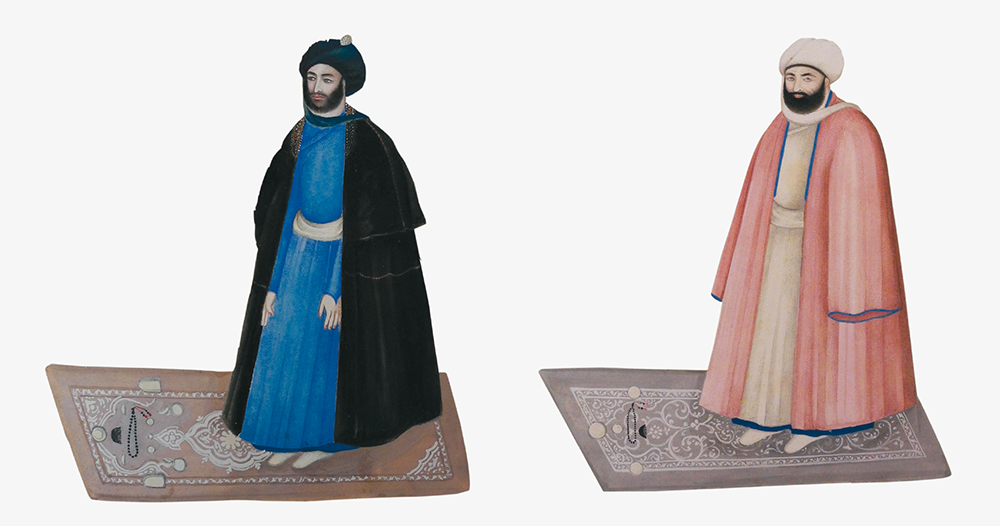
Among the different types of carpets, the ‘prayer rug’ is sacred ground par excellence, a portable and foldable ‘holy precinct’ used to pray [3].


3. Bhojraj, Portrait of Prince Muhammad Buland Akhtar at Prayer, c. 1700 –1750. Courtesy The Metropolitan Museum of Art, New York
4. A temporary place of worship outside the mosque. Photo Tomas Dirrix
With its woven, architectonic motifs and its orientation towards Mecca, it acts as a temporary place of worship outside the mosque [4]. It can be used at any time, isolating worshippers from their immediate surroundings, transporting them symbolically elsewhere. The prayer rug is a space suitable for one person to perform their daily prayers, in different positions: standing, or kneeling and touching the rug with the forehead. The prayer rug features a niche that is woven into the material, indicating where the body should be positioned [5]. It represents a doorway with the form of an arch that indicates the direction to face during prayer. The form of this arch is reminiscent of the Mihrab, a gateway that symbolizes the opening towards a celestial garden, a door to paradise.
Besides being a ‘temenos’, a holy ground dedicated to praying, the prayer rug is also a canvas that represents motifs and shapes of historical, almost archaeological, architectural elements of mosques, of palaces and gardens. Its symbols tell stories of architecture, of conquests and of exchanges between different cultures and religions.

5. Prayer Carpet, Yomud, Iran, Central Asia. c. 1775 –1850. Wool, 83.5 × 129 cm. Courtesy Victoria and Albert Museum, London
Doors of Paradise
Persian spatial culture is closely bound up with gardens as ‘built environments’, with precise landscape and architectural features, and is reflected in the production of carpets, from the grid-like Chahar Bagh ‘garden carpets’ to prayer rugs. Persian prayer rugs represent openings, doors and gateways towards the garden, featuring decorated arches supported by carefully designed columns, in which the foliage rooted in the ground connects symbolically to the sky.

6. Tree of Life, Bakshaish, Northwest Persia, mid 19th century, wool, 165 × 122 cm. Courtesy Moshe Tabibnia Gallery, Milan
In the ‘Door of Paradise’ carpet, the arch frames a bi-dimensional woven image of paradise made of flowers, bushes and birds. Another beautiful example is the Kermanshah ‘Tree of Life’, where the niche frames a tree with many branches: the Tree of Life, inhabited by birds and a precisely drawn long-tailed green Alexandrine parrot, allegorically bridging the terrestrial and celestial worlds [6]. The shape of the opening and its decorative arches can be found in palace gardens, such as the Court of Lions of the Alhambra, where the columns develop as a three-dimensional petrification of their woven counterpart [7, 8].


7. Philip Henry Delamotte, Alhambra and Court of Lions, Crystal Palace, Sydenham, c. 1859. Courtesy The Metropolitan Museum of Art, New York
8. E. Therond, Gateway towards Tomb of Iltutmish, Qutb Mosque, Delhi, 1878. Photo Alamy
Arched Rugs
In other regions, such as Anatolia, the prayer rug’s doorway features a complex architectural structure: triple arches with a higher central unit supported by paired columns. This structure is thought to be inspired by Roman architecture and adopted by Ottomans in the architecture of their palaces and mosques, and subsequently adapted to carpets by Anatolian weavers in the 17th century. This same prayer rug typology is also found in the painting Still Life by Nicolaes van Gelder, which shows the same capitals, columns and leaves. The architecture found in carpets tells us about a system of references and exchange between different cultures and epochs, and the carpet becomes a canvas to decode [9].

9. Carpet with Triple-Arch Design, Istanbul, Turkey, c. 1575 –1590. Silk, wool, cotton, 180.3 × 136.5 cm. Courtesy The Metropolitan Museum of Art, New York
Water Pond
In line with Victor Hugo’s interpretation of Gothic cathedrals as ‘books of stone’, carpets can perhaps be seen as ‘woven texts’ to be deciphered as languages. Another prayer rug ornament that helps us discover elements of the history of architecture is found in 16th- and 17th-century Anatolian rugs, in a symbol known as the ‘keynote’ [10].


10. Niche ‘Bellini’ Carpet, Anatolia, late 16th century, 177 × 134 cm. Zaleski Collection. Courtesy of Moshe Tabibnia Gallery, Milan
11. Divriği Great Mosque and Hospital, Anatolia, 1228 –1229. Photo TRT Avaz
In such prayer rugs the base of the niche presents a small octagonal enclave entering into the field of the niche. This small octagonal shape is interpreted as a water basin, which recalls the shapes of the fountain that used to be located in the centre of ancient mosques, as is still visible in the 12th-century Divriği Great Mosque and Hospital in Anatolia [11]. In the ancient mosques that have survived, the water basin has been placed outside the building. The ‘keynote’ prayer rug can be seen as a blueprint that brings to light historical and archaeological elements of the mosque, or as an Islamic bird’s-eye view of ancient sacred grounds.
Lanterns
Other types of prayer rug represent objects connected to sacred rituals and allegories, such as hanging mosque lanterns, showing us examples of Islamic art or hinting at purification rituals that precede prayer [12].